What Campus Screens Do vs. What They Could Do (And Why 87% Are Underused)
Walk into most student unions and the noticeboard is stapled paper, half torn down, adverts for a society fair that happened three weeks ago. The lecture hall corridor has a printed timetable taped to the wall, wrong the moment a room changes. The library entrance screen, if there is one, is switched off.
87% of colleges and universities already use digital signage to improve campus-wide communication. But having the screens isn't the same as using them — most campuses are running the digital equivalent of a bulletin board on hardware capable of a great deal more.
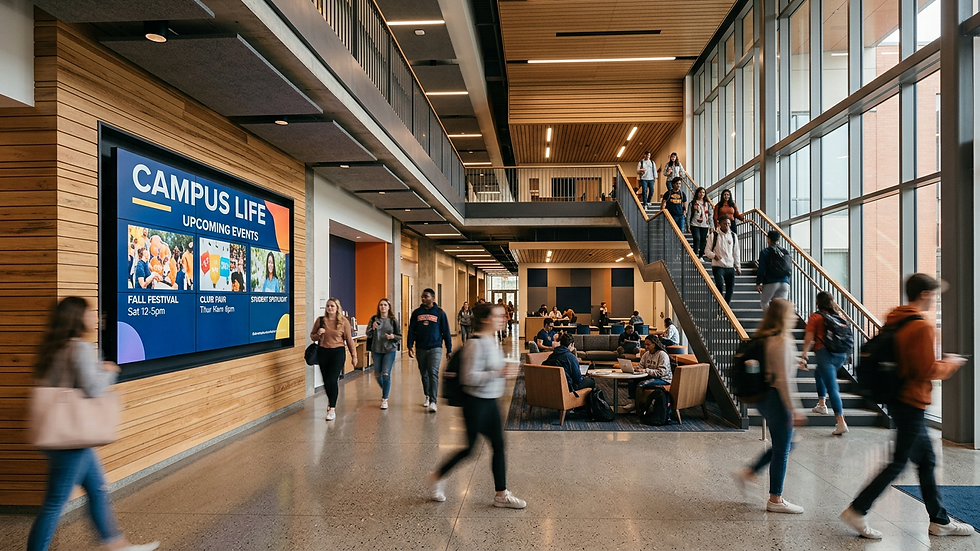
The Student Union
What it does:
A stapled noticeboard, half torn down, weeks behind whatever's actually happening.
What it could do:
Live events, society signups, and what's on today — content that changes as fast as campus life actually does.
Lecture Hall Corridors
What it does:
A printed timetable, taped to the wall, wrong the moment a room or time changes.
What it could do:
Live room changes, next class, and live wayfinding — directly reducing the confusion that sends students to the wrong building.
The Library Entrance
What it does:
A muted screen, or nothing at all, in the highest-traffic point of the busiest building on campus.
What it could do:
Study space availability and deadline reminders, turning a walk-through point into useful information at exactly the moment it's needed.
Campus Dining
What it does:
A static menu board, unchanged all term, missing whatever's actually being served today.
What it could do:
Daily menus, allergen information, and queue times — updated as often as the kitchen actually changes.
Emergency Channels
What it does:
Relies on email, easy to miss between lectures, part-time jobs, and everything else competing for a student's attention.
What it could do:
Instant campus-wide alerts pushed to every screen at once — 57% of institutions already rely on digital signage for exactly this, and it's the single highest-stakes use case on the list.
The Point of It All
Digital displays capture roughly 400% more views than static and traditional media, which is exactly why 73% of educational institutions recognise digital signage as vital to communication. The gap isn't adoption — 87% of campuses already have the hardware. The gap is content strategy: most of that signage is still running static announcements that could just as easily be printed, instead of the live, dynamic content the medium is actually built for.
That matters beyond convenience. Digital signage used well is directly linked to stronger student engagement, higher event attendance, and improved retention — because a campus that communicates clearly, in real time, feels like a campus that's on top of things.
Same Hardware, Two Outcomes
Take one student union screen. Same panel, same install, same budget. Run static announcement slides for a year and students stop looking at it within the first fortnight — it becomes wallpaper, no different from the noticeboard it replaced. Run the identical screen with live events, society signups and real-time updates, and it becomes part of how students actually find out what's happening on their own campus.
Skipping proper content planning here isn't just a missed opportunity for engagement — with 57% of institutions relying on digital signage for emergency communication, a screen network that isn't actively managed and tested is a safety gap, not just a marketing one.
This is where a managed content service earns its place: keeping event and timetable content live, building the emergency-alert workflow properly, and treating the campus screen network as a communications channel that needs the same attention as email or the student app — not a set-and-forget noticeboard.
FAQ
We already have screens across campus. Do we need new hardware?
Almost never. This is a content and management gap, not a hardware gap — the fix is what's actually running on the screens, not the screens themselves.
Can this integrate with our timetabling and events systems?
In most cases, yes. A managed content service should pull from your existing timetable, room booking, and events systems rather than requiring manual updates on top of them.
How does emergency alerting actually work across the network?
A properly configured system can override every screen simultaneously with a critical alert, regardless of what regular content was scheduled — this needs to be built and tested in advance, not assumed to work when it's needed.
Ready to Turn Your Campus Screens Into a Real Communications Channel?
CleverPosters runs the content behind campus screens like these — live events, real-time timetables, and tested emergency alerting — so your signage does more than replace a noticeboard. Book a screen content review to see what your screens could be doing.
Comments